SOLENA Luminaire in the HORTUS Office Building

Press Release
03/03/2026
Dornbirn, Austria
Zumtobel Anchors Light in the Architectural Design Concept
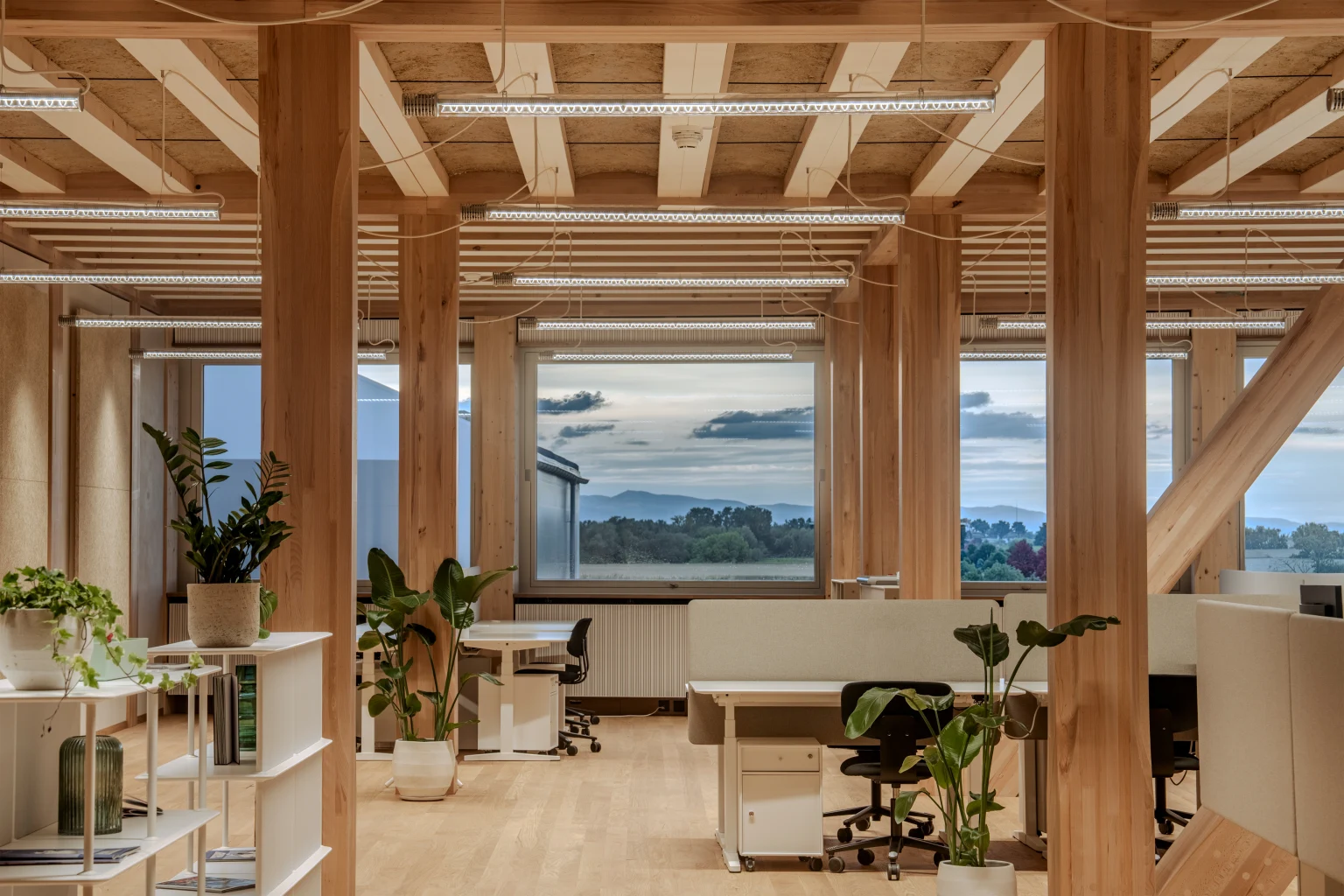
Zumtobel introduces the SOLENA pendant luminaire, developed specifically to meet the needs of the HORTUS office building at the Switzerland Innovation Park in Allschwil, near Basel. The luminaire was created in collaboration with the responsible architectural firm Herzog & de Meuron and lighting planning partner Reflexion, as part of a design process that integrates structural, energy, and material requirements directly into the architectural concept. Lighting is not considered an afterthought but rather an integral part of the building’s structure.
The multi-story timber-frame construction with rammed earth ceilings is based on renewable and recyclable materials, forgoes a conventional concrete basement, and achieves energy-positive operation, enabling the energy bound in the building materials to be amortized within 31 years. These parameters define the architectural framework within which lighting must also be considered as an integral component of the building system. The supporting structure, the thermal mass of the earth ceilings, natural humidity regulation, and the integration of renewable energy sources form a system in which spatial quality and energy performance are inseparably linked.
This configuration has specific requirements in terms of the lighting system, as it has direct impact on energy balance and room climate, while the flush-mounted material concept of wood and earth excludes visible technical elements. Light, sensors, and control systems must therefore be integrated into a single structure. “The lighting concept is part of the basic design and contributes to minimizing energy consumption. At the same time, sensors had to be integrated without burdening the ceiling with devices or cables,” explains Alexander Franz, Associate at Herzog & de Meuron. This setup fundamentally shifts the role of lighting. In the HORTUS building, light is no longer an added feature but rather an infrastructural layer of the building itself.
Development in Collaboration Between Architecture, Lighting Planning, and Industry
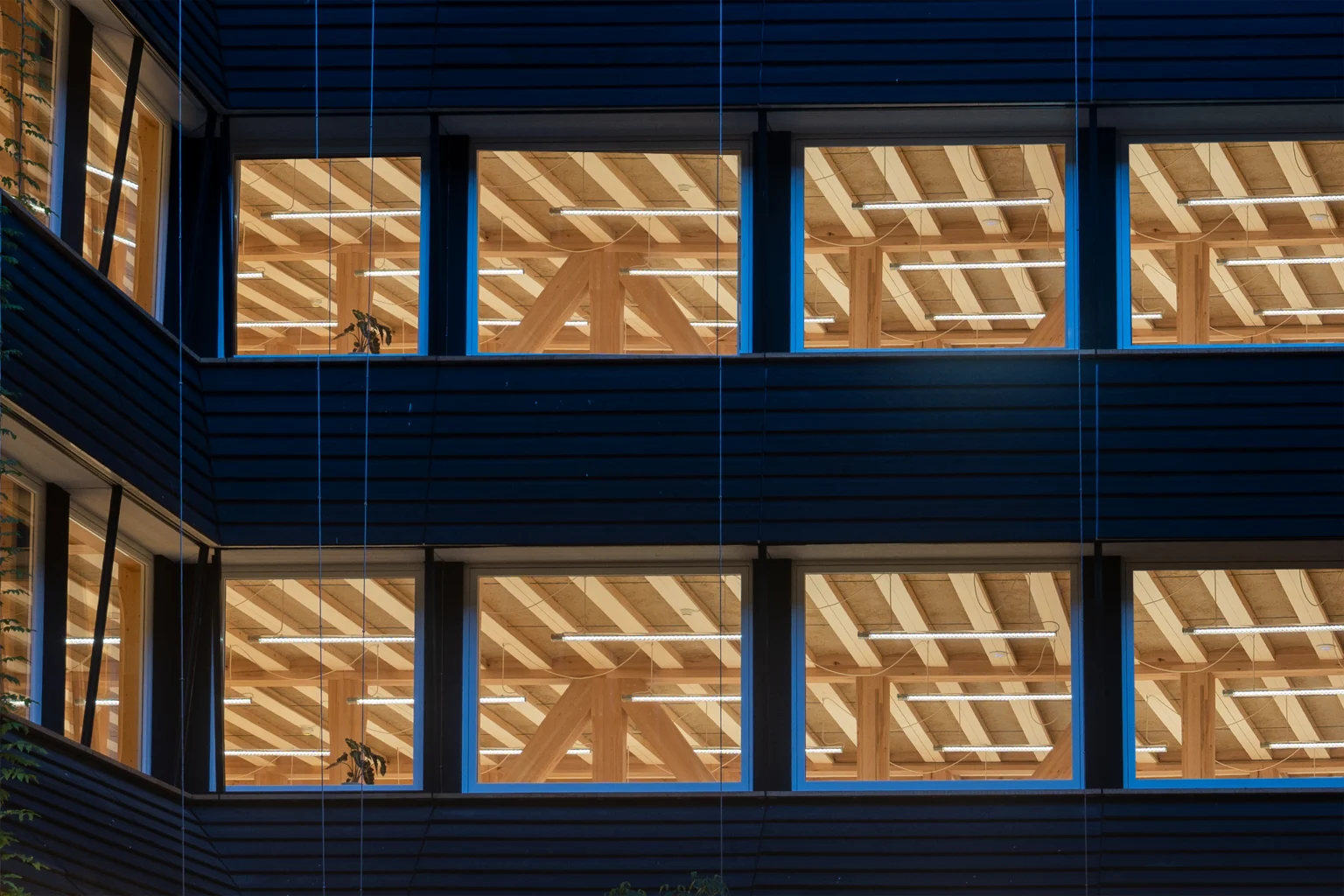
The development of the SOLENA luminaire follows an iterative approach, with ongoing adjustments between partners from architecture, lighting planning, and industry. An early prototype based on a design by Reflexion founder Thomas Mika serves as a touchstone for the interaction of architectural intent, lighting design, and technical functionality. Only on this basis could further refinement take place. Thomas Mika describes the central challenge of this phase: "The task was to develop a technically complex solution that would naturally integrate into the material and architectural clarity of the building.” A crucial aspect becomes clear: while complexity remains in the SOLENA luminaire, it is constructively bound. Its architectural impact arises from the deliberate reduction of visible technical parts. Through joint workshops, the partners developed the concept of a connected luminaire structure that takes on operational functions beyond lighting. The luminaires communicate with one another, respond to daylight and presence, and monitor parameters such as acoustics, temperature, or CO₂ concentration. Usage, energy balance, and comfort are thus integrated into a building management system.
Construction as a Result of Architectural Requirements
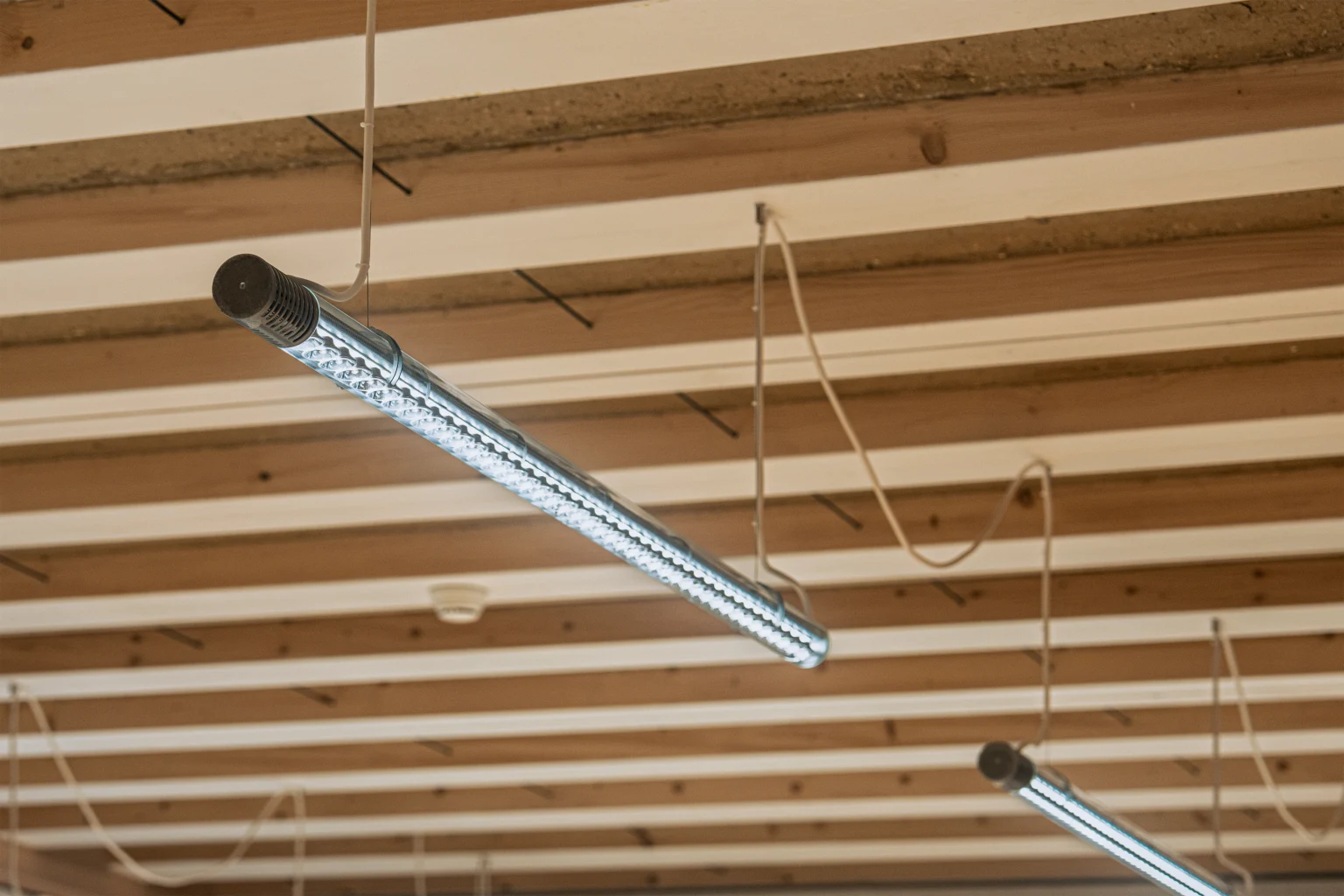
The formal design of the SOLENA luminaire reflects this consolidation of all requirements. A transparent glass body encloses a centrally positioned load-bearing profile made of folded steel sheet, which houses all the electrical and lighting components and is stabilized by circular spacers. LED boards, precise lens optics, and glare-reducing shades form a broad, dimmable light distribution with a defined color temperature of 3500 Kelvin. A deliberately minimal lateral light emission creates a subtle atmospheric light effect. The large light distribution allows for greater spacing between luminaires, supporting flexible layouts and future reconfigurations of office spaces. At the same time, all materials are dismountable and recyclable. The reduction of material use in the SOLENA luminaire is not only a constructive necessity but directly stems from the sustainability parameters of the building. The choice of materials becomes part of the overall energy and ecological strategy. The luminaire’s construction also adheres to these principles: it is designed for circularity, longevity, and reparability. The fixture is mounted via delicate steel cables and ring-shaped brackets, and multiple luminaires are connected through textile-coated cables. Even transport and packaging are designed with material efficiency and recyclability in mind. The structural openness of the luminaire also allows for adaptations in future projects, transforming it from a project-specific solution to a transferable architectural typology. This adaptability makes it clear that the value of the development lies not in the singular object but in the underlying method.
New Architectural Practice: Zumtobel as a Partner in the Architectural Design Process
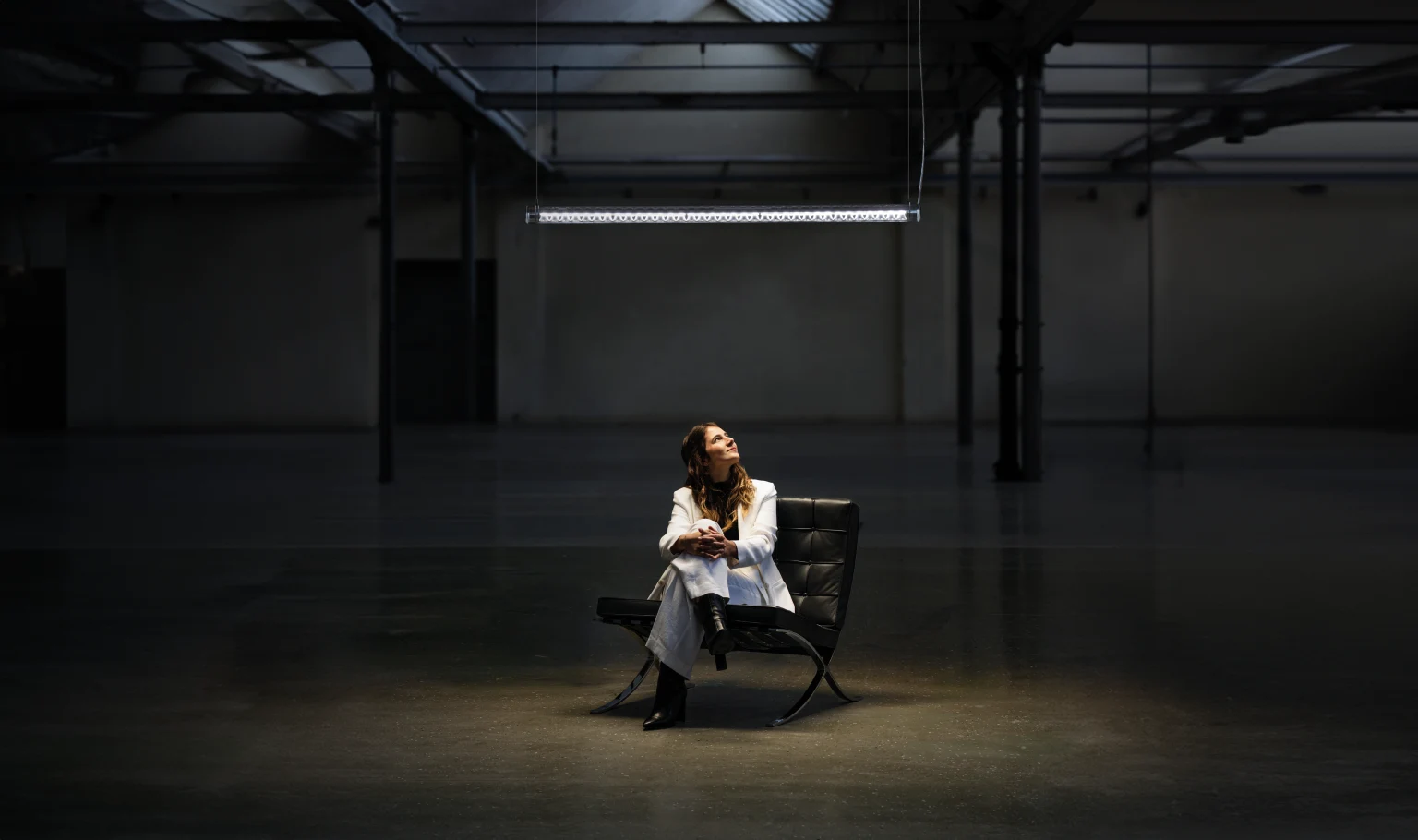
“The development of the SOLENA luminaire illustrates a changing role of industrial partners in architecture,” emphasizes Alexandru Zloteanu, Innovation Manager at Zumtobel. “Our technical expertise comes into play at a stage when architectural requirements are formulated and refined, as decisions on sensor integration, maintainability, material selection, and cost-effectiveness influence the design itself.” The project exemplifies Zumtobel Group's sustainability strategy, systematically integrating circular product development, CO₂ reduction, and material-conscious design through Circular Design Rules into the development process. The goal is to combine functional, aesthetic, and ecological requirements throughout the entire lifecycle.
SOLENA at a Glance
SOLENA is a modular pendant luminaire designed for work environments and architecturally integrated lighting solutions. A glass cylinder with a diameter of 70 millimeters and a length of 1500 millimeters encloses a central load-bearing profile that combines optics, electronics, and sensors. The luminaire achieves an efficiency of up to 166 lumens per watt and is designed as a direct/indirect lighting system with glare-free, precisely directed light distribution. The modular, maintenance-friendly structure is based on durable, recyclable materials and allows for different light distributions as well as individual color and texture variations. Integrated sensors measure room-relevant parameters such as air quality, acoustics, temperature, and CO₂ concentration, supporting integration into connected building systems. Mounting is done via ring-shaped brackets and delicate steel cables, allowing for both horizontal and vertical applications. SOLENA was developed in collaboration with the architectural firm Herzog & de Meuron and lighting planning partner Reflexion.
Press contact
Nicole Vesting
Vesting Communications GmbH & Co. KG
Klenzestraße 7
80469 Munich, Germany
Tel: +49 (0) 172 836 9922
[email protected]
vestingcommunications.com
Vesting Communications GmbH & Co. KG
Klenzestraße 7
80469 Munich, Germany
Tel: +49 (0) 172 836 9922
[email protected]
vestingcommunications.com
Marion Schwenk
Senior PR & Media Manager Zumtobel Lighting GmbH
Schweizer Straße 30
6850 Dornbirn, Austria
Tel: +43 (0) 664 80892 3977
[email protected]
z.lighting
zumtobel.com
Sales for Germany, Austria, Switzerland contact
Zumtobel Group Deutschland GmbH
Grevenmarschstraße 74-78
32657 Lemgo, Germany
Tel.: +49 5261 2120
[email protected]
www.zumtobel.de
Grevenmarschstraße 74-78
32657 Lemgo, Germany
Tel.: +49 5261 2120
[email protected]
www.zumtobel.de
ZG Lighting Austria GmbH
Advice Centre Vienna,
Lower Austria, Burgenland
Wagramer Straße 19
A-1220 Vienna
Tel.: +43 1 258 2601 0
Fax: +43 1 258 2601 82845
[email protected]
www.zumtobel.at
Advice Centre Vienna,
Lower Austria, Burgenland
Wagramer Straße 19
A-1220 Vienna
Tel.: +43 1 258 2601 0
Fax: +43 1 258 2601 82845
[email protected]
www.zumtobel.at
Zumtobel Licht AG
Thurgauerstrasse 39
CH-8050 Zurich
Tel.: +41 44 305 35 35
Fax: +41 44 305 35 36
[email protected]
www.zumtobel.ch
Thurgauerstrasse 39
CH-8050 Zurich
Tel.: +41 44 305 35 35
Fax: +41 44 305 35 36
[email protected]
www.zumtobel.ch
About Zumtobel
Our passion is to create quality lighting solutions that deliver total perfection. We are convinced, that the right kind of light can create the right atmosphere in a building at any time of day or night. When tailored to people’s individual needs, light becomes something of an experience. We are always exploring new ways to come up with unique and timeless designs and are inspired by an unrivalled creative ambition. When working on tomorrow’s lighting, we are driven by our philosophy of innovation and continuously improving the aesthetics of light. With passion, a sense of beauty and a forward-looking approach, we are constantly seeking to use light to help improve people’s quality of life. The Zumtobel brand is part of Zumtobel Group AG, based in Dornbirn in the Vorarlberg region of Austria.